If you’ve had your ear to the ground in the crochet community recently, you’ve probably heard a few whispers floating around about Hobbii, particularly around their use of AI and how some designers feel they’ve been treated. So let’s dive in.
If you don’t know Hobbii, they describe themselves on LinkedIn as “a Tech Scale-up” that’s “all about yarn.” They launched around 2015 in Denmark and quickly grew into a well known yarn company, loved for their wide range of really beautiful yarns. I even collaborated with them at one point back in the day, but I haven’t ordered from them in a long time, so over time they’ve mostly fallen off my radar.
Fast forward to a couple of weeks ago, something strange happened that piqued my curiosity. I received an email from Hobbii about joining their affiliate program. My initial thought was, “sure, I always remember them as being great,” but let this be a reminder to always do updated research before jumping into things like this. After I replied saying that would be lovely, and mentioning it would be nice to collaborate on other projects as well, I received a response surprisingly quickly (which also felt a bit odd) saying:
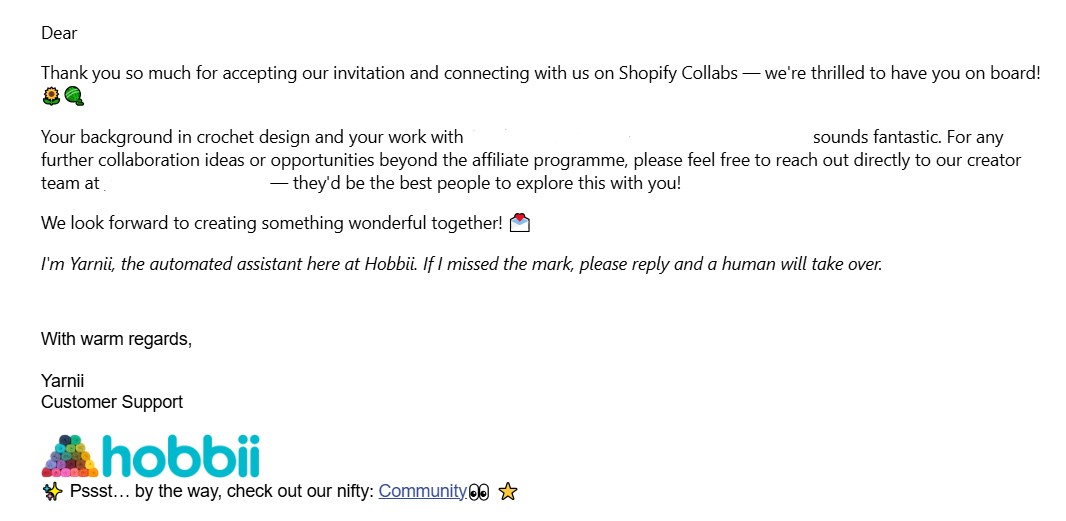
Initially the crazy use of emojis and the "—" markings didn't flag. I just thought how lovely! but then I saw it..
"
I'm Yarnii, the automated assistant here at Hobbii. If I missed the mark, please reply and a human will take over."
Suddenly the emojis made sense.
"What in the sweet doodars was this?" I thought to myself. Quickly followed by, “So everything they said was a lie?” Suffice to say, I didn’t contact their creator team. It didn’t feel like they meant anything they’d written back to me, because it didn’t even seem like a human had read what I’d said.
This prompted me to do some more research, which eventually led me to an article by EmmaKnitty titled
"Behind the Yarn: My Experience Working with Hobbii". It really opened my eyes to the situation unfolding at Hobbii, and how some employees and contractors were describing their treatment.
To summarise, her article shares her personal experience working with Hobbii, explaining how what began as an exciting opportunity filled with free yarn, strong pattern sales, and a sense of "making it" gradually shifted into something far more frustrating and unbalanced. She describes how expectations increased over time, with growing amounts of unpaid work, tighter deadlines, poor communication, and little transparency around earnings, while the benefits she had relied on steadily declined. The constant pressure to produce branded content began to affect her creativity, motivation, and even her relationship with her audience, leaving her feeling more like an extension of the company than an independent designer. Things ultimately came to a head when her contract was suddenly terminated without clear explanation, prompting her to reflect on earlier warning signs such as declining yarn quality and broader changes within the business.
I was beginning to think I had dodged a bullet.
This led me to look more closely at Hobbii’s business changes over the past few years. In April 2022, Hobbii received investment from the
private equity firm Verdane, which describes itself as “the European specialist growth equity investor” focused on two core growth themes, digitalisation and decarbonisation. More recently, Verdane has also placed a strong emphasis on AI, including in its latest AI Adoption Report, which outlines “... our checklist to help companies strengthen their visibility in AI-mediated purchase journeys,” with priorities around visibility, internal capability, and integrating AI into broader acquisition strategies.
So if this all dates back to 2022, what might be driving the recent layoffs and the suspension of designer contracts, such as those of EmmaKnitty? The most likely explanation is a combination of aggressive expansion and shifting business pressures. Hobbii scaled quickly, operating across multiple countries, sending out large volumes of free yarn to designers like myself and EmmaKnitty, and running constant global campaigns.
Across 2025 and 2026, we’ve seen layoffs happening across the e-commerce and retail sectors more broadly though, as companies tighten spending, restructure, and try to protect profitability. In that context, it’s not surprising that Verdane, as a major investor since 2022, would be asking harder questions about efficiency and returns. The usual private equity focus is growth paired with tighter margins, which often translates to doing more with fewer people.
Hobbii has already withdrawn from certain markets, including Australia and Japan, which can sometimes be a signal that parts of a growth strategy haven’t proved as sustainable as expected.
They’ve also been cutting teams tied to content and community, including areas like live events, alongside a noticeable shift toward automation and the dreaded AI-driven content. This has been reflected in recent posts on LinkedIn...
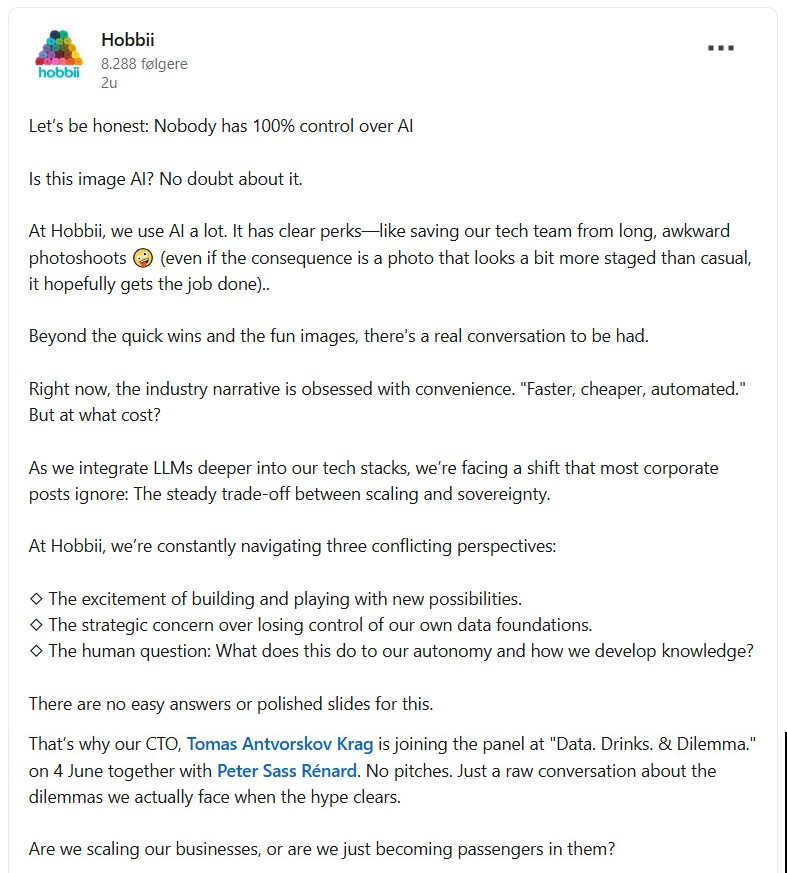
The bigger issue, though, is that Verdane and Hobbii appear to be approaching the yarn world through a tech-first lens that doesn’t always align with how this community actually works. Hobbii has stated on LinkedIn that “we’ve got e-commerce in our DNA, and tech is the way we’ll achieve our ambitious plans,” alongside ambitions to “revolutionise the industry.” But it raises the question of how well that framing fits a community built around making, creativity, and material craft rather than technology or optimisation metrics.
From the outside, it can feel like there’s a growing disconnect between how the company is positioning itself and what the yarn and crochet community actually values. A key concern within the community is the idea that AI could become something of a nemesis to traditional crafting practices. And when a brand tries to “revolutionise” an industry it may not fully understand, it risks losing touch with the very people who made it successful in the first place, which can become a recipe for disaster.
“Behind the scenes we’re a team of 411 Hobsters enjoying the crazy journey 🚀. Working at this pace means everything feels possible, there is no legacy and every day offers a dose of dopamine for making an impact…”
Hobbii’s own description of its workplace culture leans heavily into fast pace, energy, and constant output, wrapped in a deliberately playful tone full of emojis and slogans like “done is better than perfect.” On paper, it’s presented as fun, creative, and highly dynamic, but reading it another way, the language also hints at something more chaotic and high-intensity than relaxed or sustainable. The constant emphasis on speed, impact, and momentum can easily feel like pressure rather than play. Even the tone itself, with its heavy use of emojis and hype-style phrasing, comes across as closely aligned with the polished, AI-adjacent corporate voice that’s increasingly common in their social media replies.
To me, it doesn’t necessarily read like a calm, craft-led environment focused on high quality yarns. Instead it reads more like a high-energy, always-on culture where “fun” and “pace” are tightly intertwined. And some in the community have also pointed to perceived changes in yarn quality and consistency over time, which they associate with wider cost-cutting pressures as the company has scaled.
I can't speak for the yarn as I haven't received any in years, but I can comment on the use of AI. Do I hate AI? Personally, it depends. I think it can be a useful tool for sparking inspiration and finding quick information, especially now that search engines are so cluttered with ads. I’ve even been known to test it myself, asking it to design crochet flowers, usually with fairly hilarious results. But there’s also a much darker side to AI. The rise of fake crochet patterns being sold online, AI-generated craft images flooding social media, and in some cases the automation of creative jobs are all very real concerns. It’s already affecting art, communities, and livelihoods in ways that can’t be ignored.
For me, the issue isn’t AI itself so much as how it’s being used and by whom. Whether or not it should exist is almost beside the point now, it already does, and in many ways it has for longer than people realise. The question is how we choose to engage with it. I do think we need to adapt, but we also need clear boundaries and regulation around its use. Within parts of the crochet community, AI also carries a fairly negative reputation, which is why I feel this is an area where Hobbii may have missed the mark.
Deramores, if you remember them, effectively came to an end in 2022, fairly abruptly after around a decade of trading. While some point to financial strain and competitive pressure, a large part of it ultimately resulted in their business being absorbed by LoveCrafts.
I personally felt they had lost touch with the yarn community as well, and, in my experience, I didn’t feel designers were being treated particularly well, such as myself. At the time, it already felt like a company moving away from its community roots, and in hindsight, it’s hard not to see that as part of the broader decline.
Looking back at Hobbii, what stands out most is how gradually the balance seemed to shift. What began as a company that felt deeply rooted in the yarn community started to feel more like a business where scale, output, and growth increasingly took priority. And of course, once profit and expansion become the main drivers, community inevitably starts to feel secondary.
I don’t think this is unique to Hobbii or Deramores, but my experiences and others have made it very visible. The more a brand grows, the harder it becomes to hold onto the slower, more human side of craft, the part built on relationships, creativity, and shared enthusiasm rather than metrics and output. For me, that’s the real takeaway. Not just what changed, but what gets quietly lost when the focus shifts too far in one direction.
Time will tell how this will all play out.