If you’ve spent enough time in the crafting community, you’ve probably noticed the debate over whether crafting should be political or not. Some makers weave their beliefs into their work, using yarn and stitches to show solidarity or support for a cause. Others raise eyebrows, calling it performative, inappropriate, or insufficient, arguing that activism should be louder or more direct. Yet this tension isn’t new. Crafters have long wrestled with whether domestic, hands-on work belongs in the realm of politics, a debate stretching back decades, even centuries.
Throughout history, crafting has often been dismissed as a form of resistance. Protests are expected to be loud, disruptive, unmistakable, whereas crafting works slowly, quietly, but that is precisely its power. It warms bodies, remembers names, and refuses to shout, stage, or demand attention in the way we expect protests to behave. It is this very refusal that unsettles critics far more than open opposition ever has.
Gandhi’s philosophy of quiet, principled action offers a useful comparison. His nonviolent resistance emphasised moral power without spectacle. Resistance, in his view, wasn’t about making noise for its own sake, it was about acting consistently, visibly or not, and letting the weight of action speak for itself. The 1930 Salt March for example, a pivotal nonviolent protest against British salt monopoly in India, wasn’t designed to shock, it was about doing the right thing peacefully, letting moral clarity carry the message. Craftivism works in the same way. A knitted blanket for detained families, a stitched banner, or a crocheted sash is an act of care or resistance, even if no media camera is watching.
Some ask, “
What’s the point if no one is watching?” But not all acts of resistance are designed to be seen. Gandhi didn’t march for applause, he marched to make injustice harder to ignore and to keep moral pressure alive. Similarly, a blanket for a detained child or a crocheted sash in solidarity directly helps and witnesses someone, whether anyone else notices or not. The work itself, the stitch, scarf, or blanket, is already a message and a lifeline.
Quiet solidarity is about preserving humanity, not gaining attention. When people suffer under war or oppression, receiving care quietly can be radical. Showing that someone cares without spectacle challenges systems that prefer people to be ignored or invisible. Silent care can be louder than slogans because it persists where spectacle fades.
Historically, craft has been political precisely because it could happen under the radar. Suffragette-coloured scarves, blankets for soldiers, and stitched testimonies under dictatorships were often invisible at the time, but incredibly powerful. Visibility is not required for effectiveness. Modern crafters are sometimes criticised for not publicising their work, but craftivism is rarely about approval, it is about bearing witness, preserving dignity, and offering solidarity. That in itself is a form of accountability.
Craftivism is not intended to replace policy change, it doesn’t dismantle detention centres or rewrite law. Instead, it does something smaller and harder to argue against, it asserts that people subjected to state violence deserve care, dignity, and visibility. A blanket does not pretend to be a solution, but it insists on humanity where systems prefer abstraction.
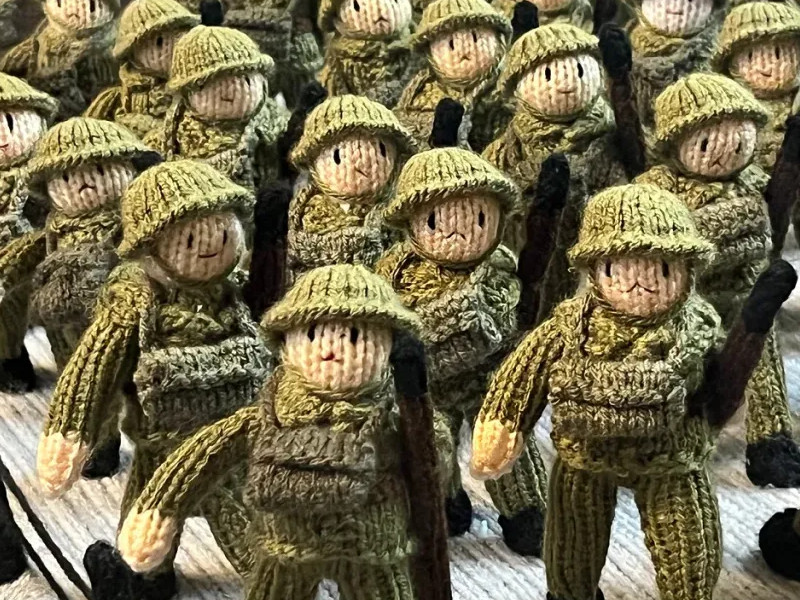
Image by The Longest Yarn: The Longest Day, created to mark the 80th anniversary of D-Day on June 6, 2024.
Crafts vs Politics
The accusation that crafts should “
stay neutral” misunderstands both craft and neutrality itself. Knitting for soldiers was never neutral. Refusing to knit was never neutral. Wearing specific colours, selling handmade work to fund causes, creating for remembrance, or passing skills through marginalised communities have always been political acts. Neutrality is simply easier to defend when it aligns with power because the idea of being neutral isn’t inherently moral or safe, it’s often just a way to preserve existing power structures.
Silence is also frequently misread. In many historical contexts, silence was not the absence of resistance but its safest form. Textiles have carried grief, testimony, and defiance precisely because they could pass unnoticed. When speech was dangerous, stitches spoke. Women in Chile under Pinochet stitched arpilleras depicting raids and disappearances. British suffragettes wore coded sashes. Knitters in occupied Europe and quilters along the Underground Railroad conveyed messages of resistance invisible to those in power. In Ireland and Scotland, lace and knitwear expressed nationalist identity under suppression. In all these cases, stitches spoke when voices could not, preserving stories, solidarity, and defiance.
But what unsettles critics the most is not that craft is ineffective as a form of resistance, but that it shows politics can happen at home. Kitchens, sofas, and laps are not separate from real-world issues. Acts of care, like making blankets or banners, are not distractions from justice, they are some of its earliest forms. Craft can be a quiet act of resistance, and that challenges the expectation that politics must always be loud or public. Quiet care doesn’t replace marches or lobbying, but it deserves respect as a powerful form of activism, because it insists on not being ignored.
Craftivism does not ask to be the only response. It just asks not to be dismissed as the wrong one.